terça-feira, 31 de março de 2020

Descubra como transformar seu negócio físico em um negócio digital

Entenda por que mudar do negócio físico para o digital pode trazer muitos benefícios para você.

O post Descubra como transformar seu negócio físico em um negócio digital apareceu primeiro em Hotmart.

Descubra como transformar seu negócio físico em um negócio digital publicado primeiro em https://blog.hotmart.com/


A publicação Descubra como transformar seu negócio físico em um negócio digital apareceu primeiro em https://ift.tt/2xQXPJN

10 ideias de produtos para você criar seu primeiro negócio digital

Se você tem interesse em empreender na internet, descubra agora 10 ideias de produtos digitais para começar hoje mesmo!

O post 10 ideias de produtos para você criar seu primeiro negócio digital apareceu primeiro em Hotmart.

10 ideias de produtos para você criar seu primeiro negócio digital publicado primeiro em https://blog.hotmart.com/


A publicação 10 ideias de produtos para você criar seu primeiro negócio digital apareceu primeiro em https://ift.tt/2xQXPJN

Por que devo comprimir vídeo?

Conheça ferramentas para não perder qualidade!

O post Por que devo comprimir vídeo? apareceu primeiro em Hotmart.

Por que devo comprimir vídeo? publicado primeiro em https://blog.hotmart.com/


A publicação Por que devo comprimir vídeo? apareceu primeiro em https://ift.tt/2xQXPJN

segunda-feira, 30 de março de 2020

Vender pela internet começando do zero: um guia completo!

Descubra o que você pode vender online, como ter um negócio virtual sem investir dinheiro, como divulgar seus produtos e muito mais.

O post Vender pela internet começando do zero: um guia completo! apareceu primeiro em Hotmart.

Vender pela internet começando do zero: um guia completo! publicado primeiro em https://blog.hotmart.com/


A publicação Vender pela internet começando do zero: um guia completo! apareceu primeiro em https://ift.tt/2xQXPJN

Descubra como ganhar dinheiro como Afiliado em 5 passos

5 dicas para quem está começando a vender produtos digitais!

O post Descubra como ganhar dinheiro como Afiliado em 5 passos apareceu primeiro em Hotmart.

Descubra como ganhar dinheiro como Afiliado em 5 passos publicado primeiro em https://blog.hotmart.com/


A publicação Descubra como ganhar dinheiro como Afiliado em 5 passos apareceu primeiro em https://ift.tt/2xQXPJN

sexta-feira, 27 de março de 2020

Como divulgar seu conteúdo para clientes?

Veja dicas para trazer clientes do seu negócio físico para o ambiente digital.

O post Como divulgar seu conteúdo para clientes? apareceu primeiro em Hotmart.

Como divulgar seu conteúdo para clientes? publicado primeiro em https://blog.hotmart.com/


A publicação Como divulgar seu conteúdo para clientes? apareceu primeiro em https://ift.tt/2xQXPJN

Aprenda a transformar o seu conteúdo em vídeo e crie videoaulas incríveis!

Se você pensa em entrar no mundo das videoaulas, precisa aprender a transformar seus materiais em vídeo. E a gente te ensina como fazer isso sem gastar muito.

O post Aprenda a transformar o seu conteúdo em vídeo e crie videoaulas incríveis! apareceu primeiro em Hotmart.

Aprenda a transformar o seu conteúdo em vídeo e crie videoaulas incríveis! publicado primeiro em https://blog.hotmart.com/


A publicação Aprenda a transformar o seu conteúdo em vídeo e crie videoaulas incríveis! apareceu primeiro em https://ift.tt/2xQXPJN

Como planejar o conteúdo de suas aulas online?

Dicas para reutilizar os conteúdos de suas aulas presenciais em aulas online.

O post Como planejar o conteúdo de suas aulas online? apareceu primeiro em Hotmart.

Como planejar o conteúdo de suas aulas online? publicado primeiro em https://blog.hotmart.com/


A publicação Como planejar o conteúdo de suas aulas online? apareceu primeiro em https://ift.tt/2xQXPJN

Descubra o que é automação de instagram e quais as melhores ferramentas

Conheça as melhores ferramentas de automação de Instagram e economize tempo na rede!

O post Descubra o que é automação de instagram e quais as melhores ferramentas apareceu primeiro em Hotmart.

Descubra o que é automação de instagram e quais as melhores ferramentas publicado primeiro em https://blog.hotmart.com/


A publicação Descubra o que é automação de instagram e quais as melhores ferramentas apareceu primeiro em https://ift.tt/2xQXPJN

quinta-feira, 26 de março de 2020

A importância do design gráfico para empresas e negócios locais!

Se eu te perguntasse agora, quantas vezes por dia você tem contato com o design gráfico ? Qual seria sua resposta ?

Provavelmente algo como “poucas vezes”, “raramente” ou até mesmo “não sei”.

Todas essas respostas estão erradas, e quem respondeu “quase o dia todo” acertou em cheio!

A princípio pode parecer besteira, mas o design gráfico está presente em grande parte da nossa vida, até mesmo quando não percebemos.

Por exemplo, quando você vê um outdoor numa avenida movimentada, isso é um trabalho de design gráfico, um flyer de evento que chamou sua atenção, uma postagem legal de uma empresa no seu feed do Facebook, o cardápio do restaurante que você gosta de ir com sua esposa e filhos, tudo isso é feito por uma empresa de designer gráfico.

Quando falamos em refrigerante, a primeira marca que vem á cabeça de muita gente é a Coca-cola, e sabe porquê ? Pois sua identidade visual é forte e marcante, e desenvolver a identidade visual de uma marca também é trabalho do designer gráfico.

Hoje em dia, ganhar a atenção de seus potenciais clientes é cada vez mais difícil.

Mais empresas a disputam, mais produtos, mais serviços, a concorrência é feroz, e quem consegue se destacar visualmente já está um passo a frente.

Afinal, a primeira impressão é a que fica, não é mesmo ?


O que é design gráfico ?

o-que-a-design-grafico
Negócio foto criado por – freepik

Design gráfico pode ser definido como a arte de comunicação visual.

Um conjunto harmonioso de imagens, elementos textuais, desenhos, diagramas e afins, que compõem uma peça gráfica. Que por suas vez reproduz uma mensagem, ideia ou um conceito.

Um designer gráfico usa sua criatividade para reproduzir – através de técnicas formais e estruturadas – mensagens, ideias ou conceitos através do apelo visual.

Uma peça gráfica bem desenvolvida é capaz de despertar sensações ao público sem precisar dizer absolutamente nada.

Dessa forma, concluímos que, o ditado é verdadeiro: uma imagem vale mais do que mil palavras! 


Qual a importância do design gráfico para empresas ?

importancia-do-design-para-empresas
Negócio foto criado por – peoplecreations

Qual a importância da logo da sua empresa ? Qual a importância da faixada da sua loja ? Da embalagem do seu produto ?

É simples de entender a importância de um design gráfico bem feito. Mas mesmo assim, muitas empresas ignoram esse fato, sem saber quais consequências ele pode causar.

Do mesmo modo que a faixada de uma loja convida o cliente a entrar para conhece-la, uma foto de perfil e capa de uma rede social convidam o usuário a entrar e conhecer a sua marca.

Não temos como saber o que se passa na cabeça das pessoas ao ter contato com a nossa marca, por isso, devemos nos esforçar para causar boa impressão e passar uma mensagem clara e objetiva de quem somos.


Qual o momento de contratar esse serviço ?

quando-contratar-um-designer
Negócio foto criado por – yanalya

Serviços de design gráfico atendem quaisquer segmentos de mercado, isso é fato.

Porém, cada negócio vive um momento distinto, e enquanto para um já passou da hora de investir nesse tipo de serviço, para outros talvez não seja o momento adequado.

Por exemplo, se o seu negócio passa por momentos de alta volatilidade, acrescentar uma estratégia que demande serviços de design pode acabar prejudicando as estratégias atuais.

Por outro lado, se o momento é menos volátil e as projeções são boas, entrar com um serviço de design gráfico para alavancar e melhorar suas estratégias de marketing com certeza é uma excelente escolha.

De um modo geral, se o seu negócio precisa crescer, melhorar ou criar a identidade visual, tirar melhor proveito de estratégias de marketing, se comunicar melhor visualmente, divulgar um evento ou simplesmente fazer camisetas para sua equipe, um especialista em design certamente vai agregar valor ao time.

Entre os serviços de design mais comuns estão:

  • livros;
  • logotipos;
  • revistas;
  • cartazes;
  • papelaria;
  • adesivos;
  • projetos editoriais;
  • panfletos;
  • banners;
  • camisetas;
  • jornais;
  • sinalização;
  • peças audiovisuais;
  • símbolos;
  • criação visual de sites;
  • banners para internet, etc.


O design nas estratégias de marketing 

design-nas-estrategias-de-marketing
Negócio foto criado por – rawpixel.com

Imagine a seguinte situação.

Você entra em um restaurante, com fome, e pede um maravilhoso hambúrguer e uma coca-cola bem gelada, com um limãozinho para acompanhar.

30 minutos depois, sua comida chega, mas, quando o garçom traz seu prato, a coca-cola bem gelada não vem junto, ela não está disponível. Meio frustrante não é ?

Você saboreia o hambúrguer, pois está com fome, mas a sensação não é a mesma, algo está faltando, não está 100%.

Quando falamos do design gráfico em estratégias de marketing, é a mesma coisa.

Seus anúncios são bem feitos, geram muito tráfego, tem bons resultados, mas não são bonitos, visualmente falando, deixam muito a desejar, ou seja, não estão 100%, algo está faltando.

Nesse nosso exemplo, peças de design bem feitas podem ser o que falta para sua estratégia de marketing decolar, ou mesmo para tirá-la do lugar.

Partes diferentes de uma mesma estratégia se complementam, uma precisa da outra.


Serviço de design gráfico em Varginha

design-grafico-em-varginha
Negócio foto criado por – freepik

A InFocus é a primeira empresa espacializada no serviço de design gráfico em Varginha. 

Além de nossa especialização em tráfego, contamos com designers experientes e criativos, que complementam nossas estratégias de marketing digital e as tornam altamente efetivas.

Diferente das agências convencionais que gastam recursos e tempo fazendo apenas post bonitos, nos preocupamos em criar designs que vendem, combinados com uma gestão de tráfego eficiente, para gerar os melhores resultados possíveis.

Portanto, podemos afirmar com tranquilidade que, em nosso segmento de mercado, combinamos as melhores estratégias de marketing, visando sempre o crescimento e expansão da marca, criação e nutrição de base clientes e aumento de faturamento, sempre aproveitando ao máximo e da melhor maneira possível o orçamento disponível.

Quer conhecer mais do nossos trabalhos de design ? Basta clicar aqui para acessar nossa galeria!


Obrigado pela leitura!

O post A importância do design gráfico para empresas e negócios locais! apareceu primeiro em Gestão de tráfego e Design gráfico em Varginha.

A importância do design gráfico para empresas e negócios locais! publicado primeiro em http://infocusced.com.br


A publicação A importância do design gráfico para empresas e negócios locais! apareceu primeiro em https://ift.tt/2xQXPJN

Design gráfico para empresas e negócios locais! Entenda sua importância nas estratégias de marketing!

Se eu te perguntasse agora, quantas vezes por dia você tem contato com o design gráfico ? Qual seria sua resposta ?

Provavelmente algo como “poucas vezes”, “raramente” ou até mesmo “não sei”.

Todas essas respostas estão erradas, e quem respondeu “quase o dia todo” acertou em cheio!

A princípio pode parecer besteira, mas o design gráfico está presente em grande parte da nossa vida, até mesmo quando não percebemos.

Por exemplo, quando você vê um outdoor numa avenida movimentada, isso é um trabalho de design gráfico, um flyer de evento que chamou sua atenção, uma postagem legal de uma empresa no seu feed do Facebook, o cardápio do restaurante que você gosta de ir com sua esposa e filhos, tudo isso é feito por uma empresa de designer gráfico.

Quando falamos em refrigerante, a primeira marca que vem á cabeça de muita gente é a Coca-cola, e sabe porquê ? Pois sua identidade visual é forte e marcante, e desenvolver a identidade visual de uma marca também é trabalho do designer gráfico.

Hoje em dia, ganhar a atenção de seus potenciais clientes é cada vez mais difícil.

Mais empresas a disputam, mais produtos, mais serviços, a concorrência é feroz, e quem consegue se destacar visualmente já está um passo a frente.

Afinal, a primeira impressão é a que fica, não é mesmo ?


O que é design gráfico ?

o-que-a-design-grafico
Negócio foto criado por – freepik

Design gráfico pode ser definido como a arte de comunicação visual.

Um conjunto harmonioso de imagens, elementos textuais, desenhos, diagramas e afins, que compõem uma peça gráfica. Que por suas vez reproduz uma mensagem, ideia ou um conceito.

Um designer gráfico usa sua criatividade para reproduzir – através de técnicas formais e estruturadas – mensagens, ideias ou conceitos através do apelo visual.

Uma peça gráfica bem desenvolvida é capaz de despertar sensações ao público sem precisar dizer absolutamente nada.

Dessa forma, concluímos que, o ditado é verdadeiro: uma imagem vale mais do que mil palavras! 


Qual a importância do design gráfico para empresas ?

importancia-do-design-para-empresas
Negócio foto criado por – peoplecreations

Qual a importância da logo da sua empresa ? Qual a importância da faixada da sua loja ? Da embalagem do seu produto ?

É simples de entender a importância de um design gráfico bem feito. Mas mesmo assim, muitas empresas ignoram esse fato, sem saber quais consequências ele pode causar.

Do mesmo modo que a faixada de uma loja convida o cliente a entrar para conhece-la, uma foto de perfil e capa de uma rede social convidam o usuário a entrar e conhecer a sua marca.

Não temos como saber o que se passa na cabeça das pessoas ao ter contato com a nossa marca, por isso, devemos nos esforçar para causar boa impressão e passar uma mensagem clara e objetiva de quem somos.


Qual o momento de contratar esse serviço ?

quando-contratar-um-designerNegócio foto criado por – yanalya

Serviços de design gráfico atendem quaisquer segmentos de mercado, isso é fato.

Porém, cada negócio vive um momento distinto, e enquanto para um já passou da hora de investir nesse tipo de serviço, para outros talvez não seja o momento adequado.

Por exemplo, se o seu negócio passa por momentos de alta volatilidade, acrescentar uma estratégia que demande serviços de design pode acabar prejudicando as estratégias atuais.

Por outro lado, se o momento é menos volátil e as projeções são boas, entrar com um serviço de design gráfico para alavancar e melhorar suas estratégias de marketing com certeza é uma excelente escolha.

De um modo geral, se o seu negócio precisa crescer, melhorar ou criar a identidade visual, tirar melhor proveito de estratégias de marketing, se comunicar melhor visualmente, divulgar um evento ou simplesmente fazer camisetas para sua equipe, um especialista em design certamente vai agregar valor ao time.

Entre os serviços de design mais comuns estão:

  • livros;
  • logotipos;
  • revistas;
  • cartazes;
  • papelaria;
  • adesivos;
  • projetos editoriais;
  • panfletos;
  • banners;
  • camisetas;
  • jornais;
  • sinalização;
  • peças audiovisuais;
  • símbolos;
  • criação visual de sites;
  • banners para internet, etc.


O design nas estratégias de marketing 

design-nas-estrategias-de-marketingNegócio foto criado por – rawpixel.com

Imagine a seguinte situação.

Você entra em um restaurante, com fome, e pede um maravilhoso hambúrguer e uma coca-cola bem gelada, com um limãozinho para acompanhar.

30 minutos depois, sua comida chega, mas, quando o garçom traz seu prato, a coca-cola bem gelada não vem junto, ela não está disponível. Meio frustrante não é ?

Você saboreia o hambúrguer, pois está com fome, mas a sensação não é a mesma, algo está faltando, não está 100%.

Quando falamos do design gráfico em estratégias de marketing, é a mesma coisa.

Seus anúncios são bem feitos, geram muito tráfego, tem bons resultados, mas não são bonitos, visualmente falando, deixam muito a desejar, ou seja, não estão 100%, algo está faltando.

Nesse nosso exemplo, peças de design bem feitas podem ser o que falta para sua estratégia de marketing decolar, ou mesmo para tirá-la do lugar.

Partes diferentes de uma mesma estratégia se complementam, uma precisa da outra.


Serviço de design gráfico em Varginha

design-grafico-em-varginhaNegócio foto criado por – freepik

A InFocus é a primeira empresa espacializada no serviço de design gráfico em Varginha. 

Além de nossa especialização em tráfego, contamos com designers experientes e criativos, que complementam nossas estratégias de marketing digital e as tornam altamente efetivas.

Diferente das agências convencionais que gastam recursos e tempo fazendo apenas post bonitos, nos preocupamos em criar designs que vendem, combinados com uma gestão de tráfego eficiente, para gerar os melhores resultados possíveis.

Portanto, podemos afirmar com tranquilidade que, em nosso segmento de mercado, combinamos as melhores estratégias de marketing, visando sempre o crescimento e expansão da marca, criação e nutrição de base clientes e aumento de faturamento, sempre aproveitando ao máximo e da melhor maneira possível o orçamento disponível.

Quer conhecer mais do nossos trabalhos de design ? Basta clicar aqui para acessar nossa galeria!


Obrigado pela leitura!

O post Design gráfico para empresas e negócios locais! Entenda sua importância nas estratégias de marketing! apareceu primeiro em Gestão de tráfego e Design gráfico em Varginha.

Design gráfico para empresas e negócios locais! Entenda sua importância nas estratégias de marketing! publicado primeiro em http://infocusced.com.br


A publicação Design gráfico para empresas e negócios locais! Entenda sua importância nas estratégias de marketing! apareceu primeiro em https://ift.tt/2xQXPJN

Você já conferiu nossa aba especial de Páscoa?

Conheça a aba especial de Páscoa no Mercado da Hotmart e se afilie agora mesmo aos produtos relacionados ao tema.

O post Você já conferiu nossa aba especial de Páscoa? apareceu primeiro em Hotmart.

Você já conferiu nossa aba especial de Páscoa? publicado primeiro em https://blog.hotmart.com/


A publicação Você já conferiu nossa aba especial de Páscoa? apareceu primeiro em https://ift.tt/2xQXPJN

7 opções para você estudar em casa e de graça sobre o mercado digital [+ BÔNUS]

Conheça alguns conteúdos criados pela equipe da Hotmart que podem te ajudar a dar o próximo passo em sua carreira.

O post 7 opções para você estudar em casa e de graça sobre o mercado digital [+ BÔNUS] apareceu primeiro em Hotmart.

7 opções para você estudar em casa e de graça sobre o mercado digital [+ BÔNUS] publicado primeiro em https://blog.hotmart.com/


A publicação 7 opções para você estudar em casa e de graça sobre o mercado digital [+ BÔNUS] apareceu primeiro em https://ift.tt/2xQXPJN

O que é freelancer? Descubra como entrar nesse mercado

Seja para ganhar uma renda extra, ter mais tempo ou autonomia, ser um freelancer é uma ótima alternativa. Mas será que você tem o que é preciso para atuar nesse mercado?

O post O que é freelancer? Descubra como entrar nesse mercado apareceu primeiro em Hotmart.

O que é freelancer? Descubra como entrar nesse mercado publicado primeiro em https://blog.hotmart.com/


A publicação O que é freelancer? Descubra como entrar nesse mercado apareceu primeiro em https://ift.tt/2xQXPJN

quarta-feira, 25 de março de 2020

Como montar um home office perfeito para o empreendedor digital

5 dicas para organizar melhor seu espaço de trabalho!

O post Como montar um home office perfeito para o empreendedor digital apareceu primeiro em Hotmart.

Como montar um home office perfeito para o empreendedor digital publicado primeiro em https://blog.hotmart.com/


A publicação Como montar um home office perfeito para o empreendedor digital apareceu primeiro em https://ift.tt/2xQXPJN

Conheça as melhores técnicas e apps para aumentar a sua produtividade no trabalho

Dê adeus à procrastinação! Aumente a sua produtividade com as nossas dicas de hacks e aplicativos para aumentar o foco e organizar melhor o seu dia a dia.

O post Conheça as melhores técnicas e apps para aumentar a sua produtividade no trabalho apareceu primeiro em Hotmart.

Conheça as melhores técnicas e apps para aumentar a sua produtividade no trabalho publicado primeiro em https://blog.hotmart.com/


A publicação Conheça as melhores técnicas e apps para aumentar a sua produtividade no trabalho apareceu primeiro em https://ift.tt/2xQXPJN

terça-feira, 24 de março de 2020

Club Sales: como aumentar suas chances de lucrar sem investir em anúncios?

Descubra porque o Club Sales é o recurso ideal para diminuir gastos com anúncios e ainda alavancar comissões dentro da sua área de membros, o Hotmart Club.

O post Club Sales: como aumentar suas chances de lucrar sem investir em anúncios? apareceu primeiro em Hotmart.

Club Sales: como aumentar suas chances de lucrar sem investir em anúncios? publicado primeiro em https://blog.hotmart.com/


A publicação Club Sales: como aumentar suas chances de lucrar sem investir em anúncios? apareceu primeiro em https://ift.tt/2xQXPJN

[33 ideias simples] Como trabalhar em casa e gerar renda própria em 2020!

O guia mais completo para você que deseja gerar renda em casa.

O post [33 ideias simples] Como trabalhar em casa e gerar renda própria em 2020! apareceu primeiro em Hotmart.

[33 ideias simples] Como trabalhar em casa e gerar renda própria em 2020! publicado primeiro em https://blog.hotmart.com/


A publicação [33 ideias simples] Como trabalhar em casa e gerar renda própria em 2020! apareceu primeiro em https://ift.tt/2xQXPJN

8 formas de ganhar dinheiro sem sair de casa (TESTADAS E APROVADAS!)

Seja para gerar uma renda extra ou mudar de carreira, a internet oferece uma série de oportunidades para quem quer empreender. E neste post, você vai conhecer algumas delas.

O post 8 formas de ganhar dinheiro sem sair de casa (TESTADAS E APROVADAS!) apareceu primeiro em Hotmart.

8 formas de ganhar dinheiro sem sair de casa (TESTADAS E APROVADAS!) publicado primeiro em https://blog.hotmart.com/


A publicação 8 formas de ganhar dinheiro sem sair de casa (TESTADAS E APROVADAS!) apareceu primeiro em https://ift.tt/2xQXPJN

segunda-feira, 23 de março de 2020

Conheça nosso MiniCurso Professor Online: 5 aulas gratuitas para você aprender a ensinar pela internet!

São 5 aulas grátis para você levar seu conhecimento a qualquer lugar e sem sair de casa

O post Conheça nosso MiniCurso Professor Online: 5 aulas gratuitas para você aprender a ensinar pela internet! apareceu primeiro em Hotmart.

Conheça nosso MiniCurso Professor Online: 5 aulas gratuitas para você aprender a ensinar pela internet! publicado primeiro em https://blog.hotmart.com/


A publicação Conheça nosso MiniCurso Professor Online: 5 aulas gratuitas para você aprender a ensinar pela internet! apareceu primeiro em https://ift.tt/2xQXPJN

13 dicas para quem trabalha em casa e quer ser mais produtivo

Trabalhar de casa exige uma dose extra de disciplina. Confira algumas dicas para ser mais produtivo no seu dia a dia!

O post 13 dicas para quem trabalha em casa e quer ser mais produtivo apareceu primeiro em Hotmart.

13 dicas para quem trabalha em casa e quer ser mais produtivo publicado primeiro em https://blog.hotmart.com/


A publicação 13 dicas para quem trabalha em casa e quer ser mais produtivo apareceu primeiro em https://ift.tt/2xQXPJN

sexta-feira, 20 de março de 2020

Tudo o que você precisa saber sobre a técnica de decupagem

O que é, para que serve e tipos.

O post Tudo o que você precisa saber sobre a técnica de decupagem apareceu primeiro em Hotmart.

Tudo o que você precisa saber sobre a técnica de decupagem publicado primeiro em https://blog.hotmart.com/


A publicação Tudo o que você precisa saber sobre a técnica de decupagem apareceu primeiro em https://ift.tt/2xQXPJN

Descubra o que é web design e quais são os principais elementos de um site

O web design é uma área do conhecimento responsável pelo aspecto visual dos conteúdos digitais. Descubra como ele impacta na experiência do usuário.

O post Descubra o que é web design e quais são os principais elementos de um site apareceu primeiro em Hotmart.

Descubra o que é web design e quais são os principais elementos de um site publicado primeiro em https://blog.hotmart.com/


A publicação Descubra o que é web design e quais são os principais elementos de um site apareceu primeiro em https://ift.tt/2xQXPJN

quinta-feira, 19 de março de 2020

Your Email Testing Playbook for 2020 (& the Tools You’ll Need)

A/B testing is one of those techniques that, if you have enough volume to give you significant results, is pretty much guaranteed to generate better results from your marketing.

Email marketers have known this for ages, but what drives me nuts is that they waste their time on tiny little tests — instead of tackling some of the bigger, more exciting tests that yield real insights and improvements.

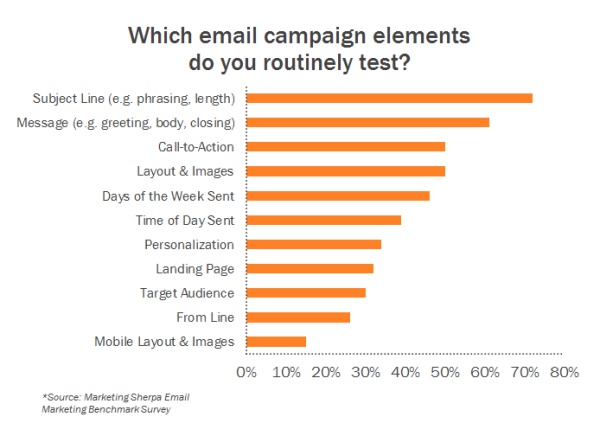
In fact, MarketingSherpa’s email survey found that subject lines are still the most commonly tested element in email marketing. Meaning that those few words that get your subscribers to open your emails and see your wonderful offers are what marketers focus on most in their attempts to optimize their email marketing.

While I’m sure this strategy can end up getting you the most tested, optimized subject line that will ever reach an inbox, the impact of these tests are minimal compared to all the other things an email marketer could be testing.

marketing sherpa email survey chart2 resized 600

So … are you ready to run some big, exciting tests? In this blog post, we’ll highlight what you should be experimenting with and which tools can help you. But, first, we’ll explain the importance of A/B testing. 

 
A/B testing is a great way to test two different newsletter formats that promote the same content or two newsletters with slightly different design elements, such as different images or types of CTAs.
 
Rather than testing one template repeatedly for a few weeks, followed by another email format test, this testing phase quickly allows you to test two styles and pick a winning template on a limited schedule.
 
As you consider A/B testing or other email experimentation, here are a few vital things you’ll want to test when building out your email marketing strategy.

Email Testing

1. Test different types of offers in your messages.

Possibly the biggest lever you have in your email marketing is not the few words you use to describe your offer, but rather, the offer itself.

Whether you’re testing two ebooks against each other, or an ebook versus a webinar, this test is bound to get you better results overall. The reason this is particularly important is, while you may think your offer is the best thing since the iPod, you may also be wrong.

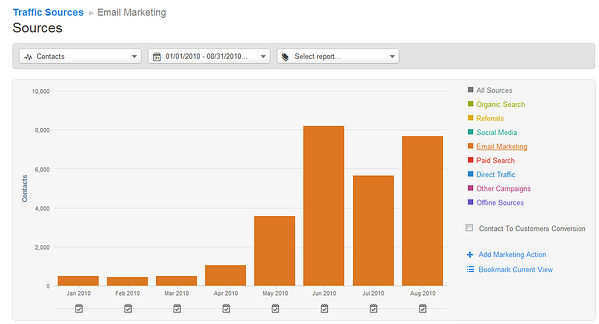
We started doing this sort of testing religiously back in the summer of 2010 and saw dramatic results. Instead of taking our email list and sending them all our latest ebook, we would take a smaller portion of the list, split it in half, send them each two different offers, and then send the better performing offer to the (larger) remainder of the list. This testing alone increased our monthly email leads 4-8x instantly.

Email leads increase

Here are some more specific offer elements you can consider testing:

  • Topic: Do certain offer topics resonate better with your audience? For example, we might test one of our ebooks on Facebook against one of our ebooks on Twitter.
  • Format: Which offer format does your list prefer? Do they love webinars? How does that compare to their interest in ebooks, kits, free trials, etc.?
  • Length/Size: Does your audience prefer smaller, bite-sized offers like tip sheets, or are they hungry for more, like an 80-page ebook? Try testing longer forms of content vs. shorter offers, or one offer vs. a set of offers.
  • Name of Offer: Sometimes the way you position your offer can make a difference with your audience. Think ebook vs. guide vs. whitepaper, or factbook vs. slideshow vs. download.

2. Analyze the landing page you’ll be linking to.

The goal of your email is not just to get someone to open or click through; it’s also to take some action. For example, to download your offer. So don’t think of your email in a vacuum. Think of it in the context of driving that particular action, which means optimizing where the action takes place: the landing page.

After all, if you create this great email that drives lots of clicks to your website but then you lose those potential leads at the last stage, it’s like you’ve run the first leg of a marathon but then decided to drop out of the race during the very last mile.

Here are some important landing page elements to test:

  • Description of Offer: The way you position your offer may have an impact. Calling out that a consultation is free, or referencing testimonials of people who have downloaded that offer, for example, can be interesting variables to test.
  • Length of Description: Do you go on and on about your offer, providing testimonials and screenshots, or do you keep things short and sweet in bullet point form?
  • Image/Preview of Offer: Using a supporting image is great, but what do you show? An image of the ebook cover, a sample page of the ebook so people can see what’s inside, or a preview of the first few pages?
  • Form Placement: Do you put the form on the left? The right? Below a block of text? Best practices say make it visible on immediate page load (above the fold), but feel free to play around with the placement.
  • Number of Form Fields: What data do you really need from your prospects? Fewer form fields usually leads to a higher conversion rate, but you should always test asking the bare minimum versus asking for every personal detail — and somewhere in between. We’ve also published some great advice about this debate here.
  • Which Form Questions to Ask: In addition to the number of form fields, which questions you ask on your form can have a big impact. Asking for Social Security Numbers or visitors’ first born child’s name is very different from asking for size of company or industry.
  • Form “Submit” Button Text: Do you use a straightforward, action-oriented phrase like “Download Ebook Now,” a fun option like “Let’s Go!” or a standard “Download” button? Test out the text of the button you know each lead is clicking on.

3. Leverage audience segmentation tests.

The success of your email is not just dependent on what you’re emailing or how you’re emailing it, but also *who* you’re emailing.

For HubSpot, an offer called, Agency Kit: How to Create Effective Ebooks for your Clients may get a great response from marketing agency owners, but it’d probably get a terrible response from the nonprofit marketers interested in our content.

The simple act of segmenting your email list to narrow your audience down to one that would find your content more relevant can have an amazing impact on your results.

Here are some audience segmentation tests you can run:

  • Interest: Has someone downloaded an ebook on this topic before? Do you know they have a particular challenge based on their website browsing history? Target the offers around those interests for a boost in response rate.
  • Persona: Identify your main business personas, and target your content to each one. At HubSpot, this means we send different content to small business owners than what we send to nonprofit marketers, for example.
  • Recency or Level of Engagement: Did this subscriber come to your site recently, or has it been a few months? Did they download a dozen ebooks, or just one?
  • Other Demographics: Try segmenting on other demographics collected by marketing or sales – things like industry or role or company size.
  • Lifecycle Stage: Where is this person in the sales and marketing funnel? Did they just start engaging with you, or are they in the last stages of the sales process? This article provides suggestions on what to send at each stage of the funnel.

Check out this blog post for even more examples of how you can slice and dice your email list for better segmentation.

4. Test different newsletter formats.

Changing up the format of your email can also have a surprising effect on your response rate. This could mean everything from the length of the email, to including a lot of images, to creating a simple, plain text email. Keep in mind that your results may differ depending on the type of offer.

For example, our new ebooks perform best when sent in a nicely formatted html email, while our free consultation offers perform better when sent as a simple, plain text email.

Here are some formatting elements you can test in your email marketing:

  • Plain Text vs. HTML: Simply try changing your pretty HTML email into a plain, personal-looking email to see how that changes your response rates. You might be surprised at the results!
  • Content in Text Only vs. Text and Images: At HubSpot, for example, we tend not to rely too much on images because many subscribers don’t enable or download images in their emails. That being said, some companies have had great success with using visuals to tell stories that you simply can’t convey through words alone.
  • Number of Calls-to-Action: Do you go with a newsletter style with a lot of calls-to-action, or zone in on one single offer?
  • Length of Email: Do you go short and sweet, include meaty content, or go on and on about the value of the offer?

If you have a number of different email templates or design tweaks you want to test in a limited amount of time, you could consider A/B testing. 

5. Send newsletters at different times and frequencies.

Timing is one of the most popular things marketers try to optimize. But it seems like there’s more talk about the best time to send in general, and not enough testing going on to determine the best time to send email to your own subscribers — or even a specific segment of your subscribers.

Even within HubSpot, we have segments of subscribers who respond more to emails on Mondays, Saturdays, mornings, afternoons — on top of that, all in their own timezones.

Instead of sending email at every marketer’s favorite time (Tuesdays at 10 a.m.), break away from the pack and see what works specifically for your audience in order to optimize for your particular business — and to have a better chance of breaking through the clutter of other businesses’ emails.

Consider conducting the following timing/frequency tests in your email marketing:

  • Day of the Week: If you always email on Tuesdays, try mixing it up and sending on a Monday or Saturday.
  • Time of Day: Do you always send emails in the mornings on the East Coast? Try an afternoon send — or even go for after work hours.
  • Triggered by Specific Behavior: It’s not just about when you want to send an email, it’s about when your subscriber has taken some interesting action. Try targeting your follow-up around when they take an action using marketing automation.
  • Timing Around Trigger Event: How soon after the triggering event should you send that email? Immediately? An hour later? A day later? Longer?
  • Frequency: How much should you email someone, and how much time should you leave in between? Once a month, once a week, once a day? Check out this article to help you determine your optimal email frequency.

6. Determine if your sender name or address impacts your email numbers.

If you haven’t tested a different sender name or address yet, definitely add this to your list. While best practices still apply (in other words, using a name that recipients will recognize as well as a real email address that your prospects can respond to), you can always try out different names to see how it affects your open and clickthrough rates.

Here are some sender name tests to try out:

  • Consistency vs. Change: Should you use the same name for consistency, or try changing it up email to email to garner more attention?
  • Personal vs. Company: Should you use an individual’s name, your company name, or some combination? (e.g. ‘Ellie Mirman,’ ‘HubSpot,’ or ‘Ellie Mirman, HubSpot’)
  • Category-Related Name: If you have a subscriber in a particular segment of your business, you can try sending an email from the name of that segment (e.g. ‘Small Business Team’). If your subscriber signed up for a particular type of content, try using a name related to that specific content type (e.g. ‘HubSpot Webinars)’.

HubSpot’s Free Email Software

HubSpot’s free email tool allows you to create email campaigns that can be ent to email subscribers or contacts in your CRM.

hubspot-marketing-email-drag and drop layout

Aside from providing an easy-to-use drag-and-drop software, HubSpot also allows you to test email designs through an A/B test feature. The software also provides tips related to length in the subject line and preview text area which can help you write captions and instantly verify that they won’t get cut off.

On top of all these features, HubSpot’s software will notify you if it can’t find a link in your email. It will also warn you when inboxes like Gmail will trim your message. 

Litmus

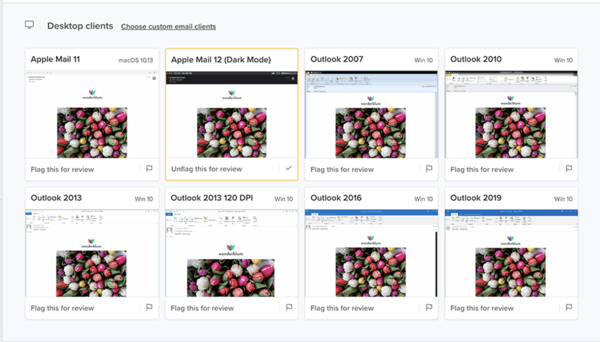
Ever wonder if your email will look aesthetically pleasing on different devices and in different email provider inboxes? With Litmus, you can sign up for free and send them the email you want to test. From there, Litmus will automatically review the email and send you screenshots showing what your message will look like to readers using different email providers. 

Litmus email design testing software

Mail-Tester

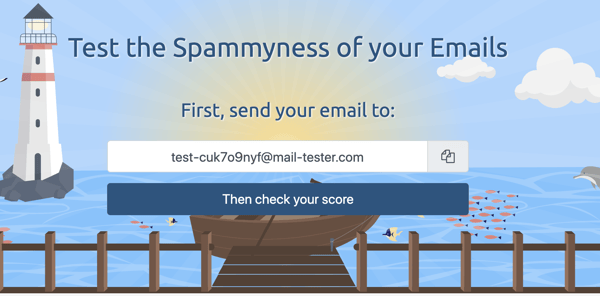
Worried you’re using phrases or wording that could trigger spam filters to burry your email? With Mail-Tester, you can log in and get a special email address to send your test email to. After you send it, Mail-Tester will send you a report that notes any of the spammy trigger words that were in your message so you can correct your language before sending to your full list.

Mail-tester email testing tool

Sender Score

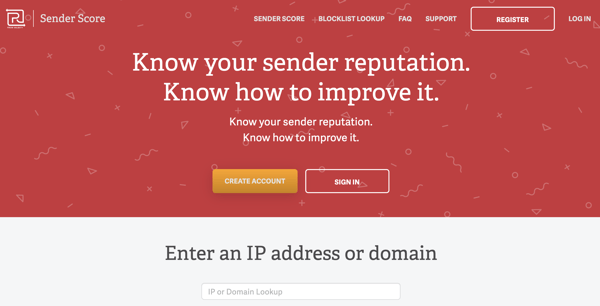
Sometimes, if your IP address is associated with sending many different email newsletters, email providers might move your email to spam. If you suspect that your IP address could be negatively impacting your email numbers, you can use SenderScore to find out if your IP address is considered “spammy.”

Sender Score IP address tester

SubjectLine

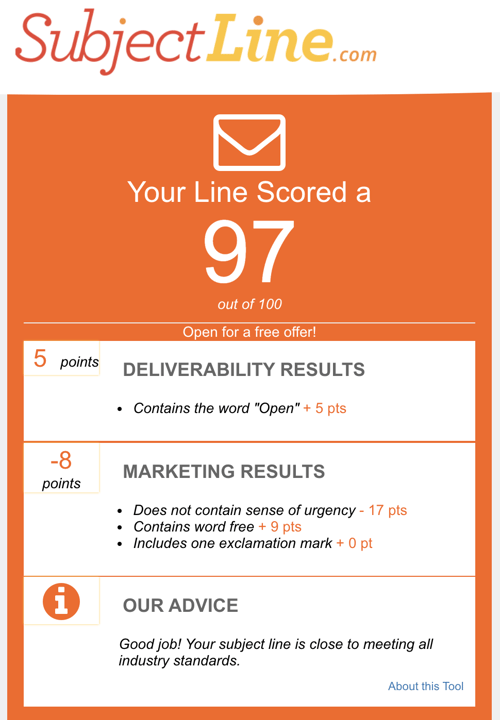
If you need help with writing subject lines, you can test a few before sending your email with SubjectLine.com. When you go to the website, you simply type in a subject line and click the submit button. Then, you’ll receive a grade out of 100 points as well as pointers for improvement. 

SubjectLine.com subject line scorecard

Reminder: Test only one thing at a time. 

The key with any of these tests is to test just one element at a time so you can isolate your variables and thus tie the difference in results is to that particular change. And if you crank through this list of BIG email tests, here are some great ideas for quick, smaller tests to; always be optimizing.

Happy testing!

Editor’s note: This blog post was originally published in 2012 but was updated for comprehensiveness and freshness in March 2020. 


Your Email Testing Playbook for 2020 (& the Tools You’ll Need) publicado primeiro em https://blog.hubspot.com/


A publicação Your Email Testing Playbook for 2020 (& the Tools You’ll Need) apareceu primeiro em https://ift.tt/2xQXPJN

How to Use Internal Linking to Improve Your Website’s SEO

Great content and attracting inbound links are major elements of your SEO strategy.

If you’ve created an exciting blog post or ebook, you’ll naturally want to work on making sure that you are driving as much traffic to it as possible. Part of that strategy should always include internal linking, and understanding how the other pages of your website can contribute value toward your new page.

If you’re working on any important campaign, it’s absolutely critical to figure out which of your already great, high-authority pages should be linking to your new page, or what ongoing efforts can continue to build link authority for your site over time. This process is called internal linking. 

With great internal linking, ranking for very difficult keyword phrases is made much easier as you share the authority of your other best content with your new efforts.

Why Internal Linking Is Important

Remember that a search engine’s ultimate goal is to surface the very best few pages about a topic on the web. With the focus that most linkbuilders and SEO specialists have on inbound links and developing links from other sites, it is easy to overlook how internal linking is important. If you’ve heard that inbound links are like other sites voting for your content and telling search engines what your content is about, internal links are like voting for yourself and also letting the search engine know about your vote.

While it’s obviously better to have more people than just yourself voting for your content, if you don’t start by voting for yourself, the search engines will have a difficult time considering your page as one of the best on the web. Internal links are valuable not just because they are a direct signal that your content is important, but also because those links themselves pass on their own link authority.

internal links flow seo juice
When you consider that the link authority of each page is being shared into your website from these internal links, the value of your blog and other linked pages is more obvious to search engines.

While these pages are ranking well and bringing traffic into your website on their own, there is a second layer of SEO benefit that they can bring to your website if you properly apply them to your internal linking strategy.

How to Establish an Internal Link Structure

If there’s a page on your website that you care about a lot and that has a lot of value to you, you should be thinking about how you can explain that value to a search engine. One quick way to do this is by creating an internal linking strategy around it.

Start by considering how a search engine understands the value of an internal link; it’s looking at how many pages on your website link to that page, and how they link to it. If every page of your website links to something, it must be important to you — like your homepage, or your blog’s homepage.

If the only links in to your blog are from your ‘About Us’ section and nothing from your homepage or your website’s main navigation, you have already sent a strong signal to search engines that your blog is not very strong.

On the other hand, if your blog is in the main navigation on your website, Google and Bing will treat it like one of your top pages.

This works similarly to specific blog posts, as well as your blog. If you write an extensive blog post that defines something, such as a strategy or trend in your industry, you can link phrases in follow-up blog posts to it to prove to Google that this page is valuable to your readers.

To leverage internal linking to the fullest, do an audit of your website’s main pages and where you can interlink between them. As you write blog posts, you can also have your writers and others publishing on your website to interlink to your other blog posts and pages when it feels natural.

To help you further develop your internal linking structure, check out the tips below. 

3 Ways to Improve the Internal Linking on Your Website

Here are three exercises you should go through to ensure you are effectively using the authority of your internal pages.

1. Sketch out a map of your website.

Make a list of each page in your main navigation and what links are on each of those major pages. This will help you understand the links that you already have between each section of your site, and how you’ve linked it together in the past. Sometimes, laying out your whole website visually is the only way to understand what you’ve overlooked and what’s working. You might just uncover that the reason some of your best pages are ranking well is because you subconsciously did a great job building your own links into them from your other content.

2. Look at the topics that you frequently write about.

If you’re writing regularly about something, you should have another dedicated page on your website about that topic — like a landing page with an offer, for example. Each of those posts should be linking to that authoritative page on the subject, and it should be optimized for conversions. If your landing page has a prominent call-to-action, your effective use of internal linking will help drive more new leads through the offer.

Also consider where that page lies in your navigation, and if it’s worth linking to from your homepage or products page. Depending on your business, you might even find that linking to a specific blog post or page from your website’s main navigation might suit you well. For example, if your company often needs to explain your business to people who discover you, that would make a good blog post that deserves major promotion across your site.

3. Think about every other page that could link to your ranking page.

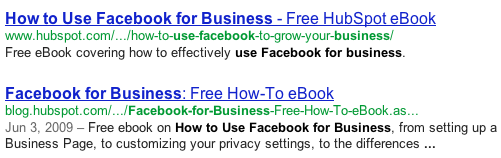
If it is a page related to a topic you frequently blog about, make sure each of your new blog posts about that topic reference that page and link into it. You can see this in how HubSpot ranks for the term ‘how to use facebook for business.’

facebook for business serp placement

One of the major factors behind its rank is that we regularly write about how to use Facebook for Business, we have a lot of very powerful links from our blog posts about using Facebook for business, and we have at least one link in each of those entries to our Facebook for Business landing page. Those blog posts we wrote over the last five years about this topic all have great authority of their own because people have linked to them, and each of them links to our landing page to further build that value.

Editor’s Note: The blog post was originally published in Feb. 2012, but was updated in March of 2020 for comprehensiveness and freshness. 


How to Use Internal Linking to Improve Your Website’s SEO publicado primeiro em https://blog.hubspot.com/


A publicação How to Use Internal Linking to Improve Your Website’s SEO apareceu primeiro em https://ift.tt/2xQXPJN

How to Calculate ROI in Marketing [Free Excel Templates]

It’s a brand new month, everyone! It’s a time for new beginnings. New campaigns, new landing pages, new blog posts, new emails, and new social media posts are all on the horizon.

But wait … aren’t we forgetting something? With last month’s activities all done, we need to pause for a second to examine what worked and what didn’t. And you can’t do that just by saying last month’s activities were “great” … “great” doesn’t pay the bills.

If you can prove that your marketing activities actually made an impact in your business, you’ll have many more opportunities at your disposal. More budget to play with. And more potential hires to bring on board. Sounds like every marketer’s dream, right?

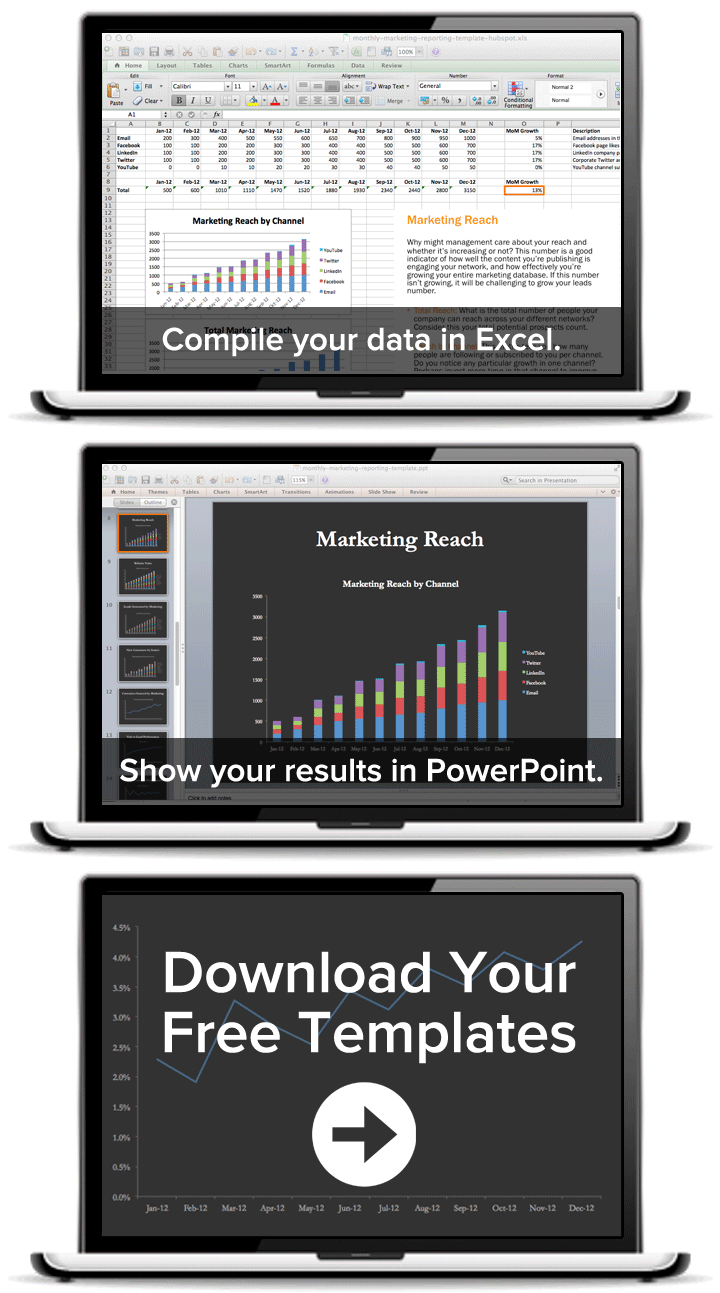
So how do you go about first, finding the right metrics to use, and second, proving your marketing’s ROI to your boss? Why, with a monthly marketing report template, of course. Download our completely revamped PowerPoint and Excel templates by clicking here, and then keep reading to learn how you can use them in real life.

For example, if you’ve been running a campaign for three months, and you’re seeing a sales growth of 5% per month, then your ROI calculation will take out that trend.

Additionally, if you’re a HubSpot customer, you can access an ROI calculator programmed with the same formula in our CRM.

Which Metrics Should You Track?

First things first — which metrics should you be paying attention to in the first place? Not all metrics were created equal, and if you’re going to capture your boss’ attention with this PowerPoint deck, you’re going to need to tell your story efficiently through data. Click through our marketing metrics template and get tips on how you can put together your marketing report deck.

How to Create Your Own Marketing Metrics Report

So now you know what metrics you need … but what about customizing the PowerPoint slides to fit your business? Follow these four steps so you’ll have engaging, accurate, and concise slides to show to your boss.

1. Download our monthly marketing reporting templates for Excel and PowerPoint.

Seriously, you haven’t downloaded it yet? 😉

mac-monthly-marketing-report-template

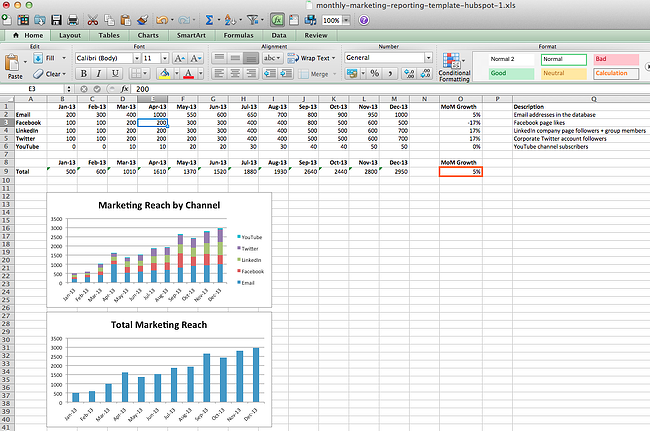
2. Open up Excel, and fill in the metrics you want to track.

Equations and graphs will automatically populate based on the metrics you add.

Excel monthly reporting template.

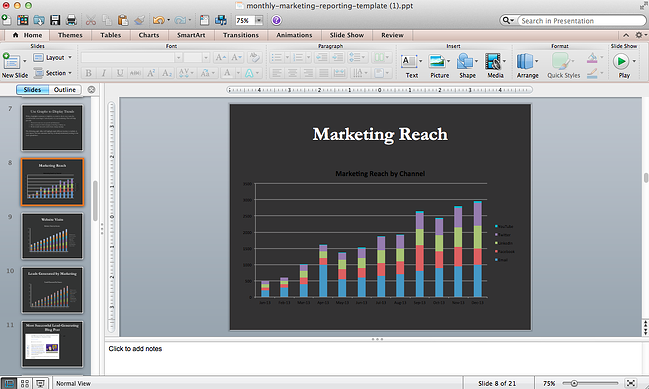
3. Copy the graphs and paste them into PowerPoint.

Marketing graphs copied into PowerPoint.

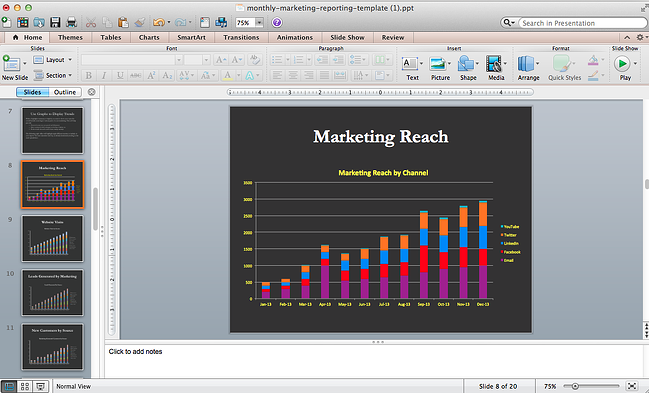
4. Customize your graphs and charts to fit your company’s theme.

After crunching a bunch of numbers, you probably need a little creative break anyway. Click on individual elements in the graph to customize them. If you really want to get fancy with your presentation, check out these five simple PowerPoint tips.

Customized charts in PowerPoint.

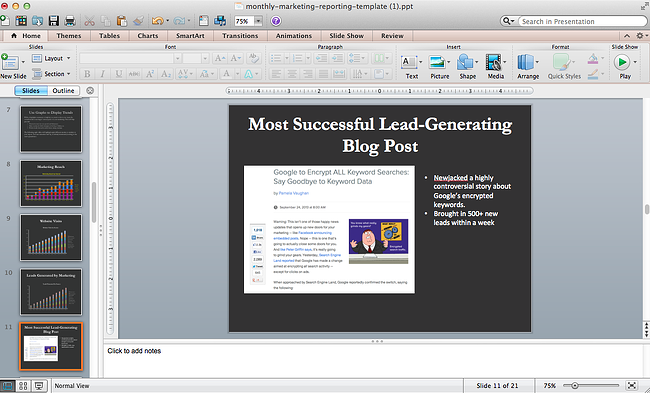
5. Add relevant examples to back up your graphs.

If you truly want to explain your marketing team’s success from the past month, don’t forget to include a slide here or there that touches on specific examples. For example, if you have a blog post that drove a crazy number of leads in a month, you could include that example slide with a few bullet-point takeaways after the “Leads Generated by Marketing” slide. These specific examples give color to your presentation and justify time spent on future projects.

Qualitative examples in PowerPoint.

ROI Excel Templates

Excel is one of the best tools to use when you’re tracking and calculating ROI on a regular basis.

Download our monthly marketing reporting templates for Excel and PowerPoint.

In the above collection of marketing reporting templates, you’ll get to fill in the following contents (and more) to suit your company:

Below, let’s review the five excel templates, and what you’ll find in each one.

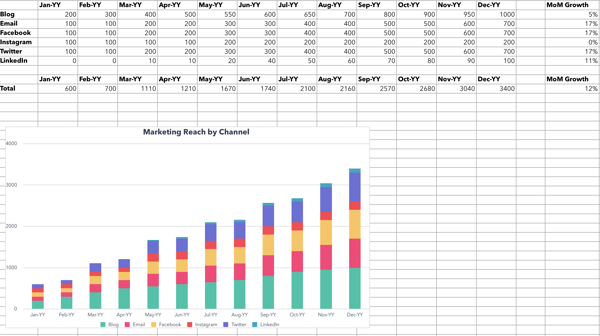
1. Reach

Excel template calculating marketing reach.

In this template, you can fill out the data to calculate your marketing reach. For example, you can calculate reach of your blog, email, or social media.

Then, the graphs below will help turn your data into a visual graph.

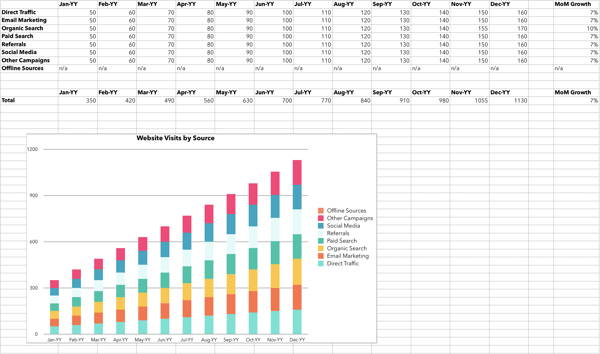
2. Visits

Graphs calculating marketing visits.

With this template, you can fill out the information to calculate your visits. This will include visits via several sources and channels including paid traffic, direct traffic, and social media referrals.

Then, the graph below will create a visualization of your data.

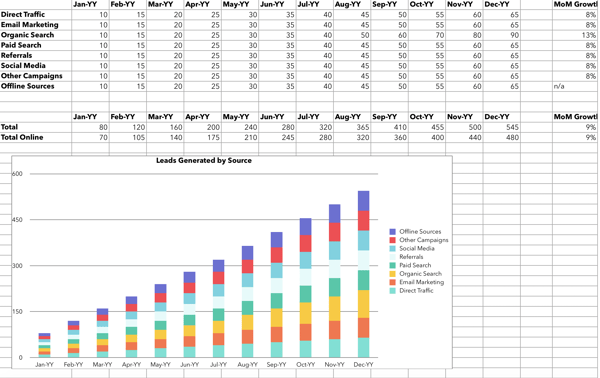
3. Leads

Excel graph calculating marketing leads.

In this template, you can input your information, for how many leads are generated with your marketing campaigns.

In the graph below, you can visualize your leads depending on the sources.

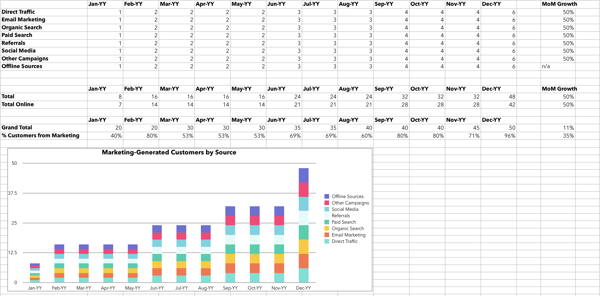
4. Customers

Excel graph for calculating customers.

In this template, you can calculate your customers via traffic source. In the below graph, you can visualize your customers.

5. Conversion Rates

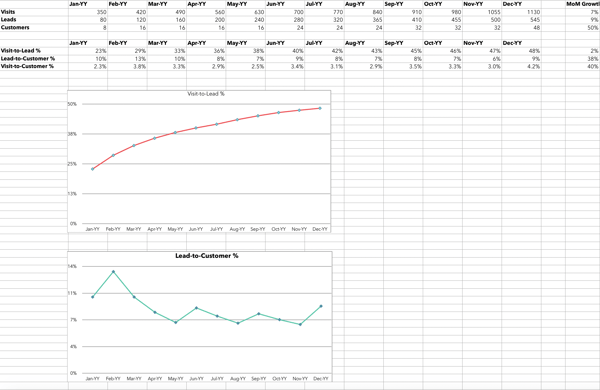
Excel template for calculating conversion rates.

In this template, you can calculate conversion rates by inputting your information.

And that’s it! Easy peasy way to track your team’s success. After a few months of this, who knows, you may have an even bigger budget or a brand new marketer on board.

Editor’s note: This post was originally published in September 2013 and has been updated for comprehensiveness.


How to Calculate ROI in Marketing [Free Excel Templates] publicado primeiro em https://blog.hubspot.com/


A publicação How to Calculate ROI in Marketing [Free Excel Templates] apareceu primeiro em https://ift.tt/2xQXPJN

The Plain-English Guide to Meta Tags & SEO

In 2018, HubSpot found 64% of marketers said they actively invest in search engine optimization (SEO). 

Good SEO can get you in front of the potential customers who are searching for your products or services, and great SEO can help those users become long-term customers, and even brand loyalists.

SEO is a landscape that involves many on-page and off-page factors, and it’s critical to understand how to incorporate meta tags into each one of your web pages. Meta tags can help search engines correctly identify and categorize your pages, which may result in higher rankings and more exposure to the audience you’re trying to reach.

If you’re anything like me, though, you might be thinking, “Wait … what’s a meta tag again?”

What Are Meta Tags?

Here, we’re going to define meta tags, identify some of the most important meta tags you need to worry about, and provide instructions so that you can begin incorporating meta tags into your HTML today.

Meta tags are useful from an SEO perspective since they allow search engines to more easily categorize your web page’s content. There are several types of meta tags and their attributes, and how you use them will depend on your strategy.

Let’s dive into some of these now.

1. Canonical Tags

If you have a single page with multiple URLs, or different pages with similar content (such as a page with a mobile and desktop version), search engines see these pages as duplicate versions of the same page.

For instance, as a human, you know “www.google.com” and “https://google.com” point to the same page — if you search for either, you’ll land on Google’s homepage.

But Google sees “www” and “https://” as duplicate versions of the same page. If you don’t specify which page you want to be the “real,” or original, source, Google will choose which source it dubs original and crawl the other pages less often.

This could mean that Google consistently crawls your mobile version of your homepage and rarely checks your desktop version.

For this reason, it’s often important to include a canonical tag, which simply tells Google, “Hey, if you find this same content elsewhere — please disregard. This is the source I want you to see, and this is the version I want to appear in the SERPs.”

This is especially important for pages like your homepage. To insert a canonical tag, simply put this code in your HTML:

<link rel=”canonical” href=”https://ift.tt/2TD2Z5p&#8221; />

2. Meta Content Type

The meta content type enables you to specify the media type (e.g. “text/html”) and character set for each web page — you’ll want to include this on all of your web pages. Different browsers render information differently, and different languages have different character sets. Using meta content type tags ensures your pages are displayed correctly on all browsers.

Here’s an example of the code you’d use for meta content type:

<meta http-equiv=”Content-Type” content=”text/html; charset=utf-8″ />

3. Robots Meta Tags

By default, search engine crawlers move through your entire site and follow internal and external links. However, this may not align with your strategy if you are looking to control how some pages appear in SERPs. In addition, a high number of outbound links may negatively affect the value passed through your links (also known in the SEO community as “link juice”).

If you don’t specify a robot meta tag, search engines will obey the default index,follow command. Robots meta tags can influence the behavior of the search engine crawling and indexing, resulting in more strategic control of how your site shows up in SERPs and what “link juice” it retains.

Here are a few common robot meta tags:

  • noindex — Prevents the page from being indexed.
  • nofollow — Prevents Googlebot from following links from this page.
  • nosnippet — Prevents a text snippet or video preview from being shown in the search results. For video, a static image could be shown instead.
  • noarchive — Prevents Google from showing the Cached link for a page.
  • unavailable_after:[date] — Allows you to specify the exact time and date you want to stop crawling and indexing of this page.

There are various reasons you might use a robots meta tag. You might input the “nofollow” command, for instance, if your web page has a comments section. Since you can’t control which links are posted by readers in the comments section (which could be off-topic to your page’s content), it might be smart to tell search engines not to follow those links.

Alternatively, “noindex” is a popular tag for a few reasons. Let’s say you’re planning to launch a website redesign, but you want to test the redesign on a development server that lives in a subdomain on your website. You’ll want to use the “noindex” tag to ensure Google won’t release the site in search before it’s ready.

You might also use “noindex” if you have a gated content offer you don’t want users to be able to find on search engines — since you want them to fill out a form to access it.

Lastly, you might use “noindex” if your website creates unique web pages whenever someone does a site search. Search engines might think those pages are part of your website, which will hurt your SEO. It’s best if you incorporate “noindex” to ensure site search results aren’t displayed on the SERPs.

To incorporate a robots meta directive, input this code into your HTML:

<meta name=”robots” content=”noindex, nofollow”>

4. Title Tags

Title tags help readers initially understand what your content is about, and they are also a major factor in helping search engines understand your content’s subject matter. Additionally, a title tag can ensure consistency, since the title tag will show up on your web page, on the web browser, and in social networks.

If you don’t include a <title> tag, Google will create one for the SERPs for you — which can hurt your ranking. Ultimately, you want to create a compelling, click-worthy title that will intrigue readers while accurately portraying what your page is about.

Include a title tag on each of your web page’s by pasting this code into your HTML:

<head>

<title>Example Title</title>

</head>

It’s important to note, alt text is technically not a tag — it’s an attribute. However, you’ve likely heard the term “alt tag”, which is why you might think alt text is part of the meta tag family (I know I did …).

Regardless of its categorization, alt text is incredibly important for your overall SEO strategy, particularly since Google places more value on visual search nowadays. When a search engine crawls your page, it’s going to look for the alt text of an image as an identifier for what your web page is about — so it’s critical you correctly title your alt text.

Here’s a code example for alt text to incorporate in your HTML: <img src=”metatag.jpg” alt=”Meta tag picture”>.

5. Meta Keywords

Meta keywords are an attribute of the “meta name” tag that get added if you want to use keywords to describe what a page is about. These keywords would not appear on the page but rather in the page’s code, and search engines used to use them as a ranking factor.

Note: While it doesn’t hurt to use them, meta keywords are no longer relevant for most SEO strategies. In 2009, Google announced that it no longer factored meta keywords into their search algorithm for ranking.

6. Meta Descriptions

Meta descriptions are one example of a meta tag — simply put, a meta description is a 160 character-limit snippet of text a user can read on a search engine. A meta description tells the user what they’ll find if they click on your content — which, if done correctly, can greatly increase click-through rates.

The tag doesn’t influence ranking directly, but it’s nonetheless an important element of SEO — a good meta description can compel readers to click on your article, and if the meta description accurately describes your content, the user is more likely to stay on the page. Click-through rates do influence search engine ranking, so meta descriptions are important for SEO.

Here’s an example of the code you’d use to manually input a meta description into your web page’s HTML:

<head>

<meta name=”description” content=”This is an example of my meta description.”>

</head>

Meta Tags vs. Meta Descriptions

These two often get conflated since they both contain the word “meta.” One thing to understand is that meta descriptions are just one example of meta tags, which encompass all of the items in the above list. 

While meta descriptions are a subcategory of meta tags, there is a fundamental difference between the two — purpose. Meta tags are used to help search engines figure out the content of your site, but meta descriptions are used to help a user sort your content.

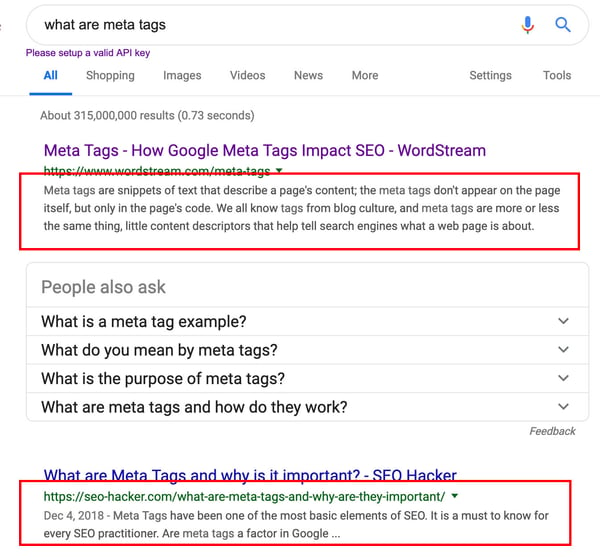
For instance, consider what happens when I search “what are meta tags”:

SERPs and meta descriptions for Google query "what are meta tags"

The meta descriptions for the following two articles are more than likely the primary reason I’ll choose one article over the other.

1. Understand that not all meta tags need to be written. Some are just codes. 

After reading this article, you’ve learned that there’s not one single “meta tag” but rather several categories that fall under this umbrella. Some meta tags require creativity while others are snippets of code that you can simply copy and paste. 

2. Create a swipe file to use for copy/pasting those codes. 

For the instances in which you don’t need to write anything, it’s helpful to have this coding handy anytime you’re creating pages. 

3. Paste the canonical tag into the HTML header if the page has duplicate content. 

As a reminder, if there are multiple versions of a page on your site, you’ll want to use canonical tags to specify the original source for that content. For any duplicate content, you can pull your canonical code from your swipe file to specify it as such. 

4. Use the robots noindex tag if you don’t want the page to show up in SERPs. 

There are many reasons you might not want a particular page to be indexed. Perhaps it’s a thank you page that should only be viewed once a user takes a certain action, or maybe it’s a piece of content that you don’t want showing up in the SERPs. Whatever your reason, the noindex tag will signal to Google not to index that particular page. 

Add this specification to your robots meta tag code in your swipe file. Then, paste it into your HTML header for the page in question.

5. Use the robots nofollow tag if you don’t want Google to follow links on this page. 

If you have a comments section where you want to prevent Google from associating random links with your website, you can do this with the nofollow tag. The nofollow tag is also helpful for controlling your site’s “link juice” in a strategic way. If you don’t want Google to follow any links on a page, pull this code from your swipe file. It also goes in the HTML header. 

6. Create a short headline to use in your title tag. This should compel readers to click. 

Your title tag should be unique for each page you create because it essentially names the page. The title tag shows in the SERPs, in the browser, and on social media. For that reason, it should be written for your target audience. Some things to keep in mind as you write: 

  • What value are you providing to them?
  • What will they get if they visit the page? 
  • What benefits or advantages do you offer?
  • How can you present that information while enticing them to click?

Another best practice is to include your page’s target keyword as close to the beginning of the headline as possible. 

7. Write a concise meta description that supports your title tag and further entices readers. 

Since the meta description also shows up in SERPs, this is an additional meta tag that essentially advertises your content. The goal here is to expand on the title/headline with enough elaboration while also enticing them to click. The challenge is doing it in under 160 words. Here are some strategies to consider: 

  • Use your primary keyword in the meta description to make it more relevant to their query, catching the reader’s eye.
  • Set the stage for the content, giving the reader expectations about what you’ll be delivering. 
  • Open a loop or create intrigue to make them want to read more.

8. Add alt text tags that are keyword-optimized and descriptive to any embedded images on the page.

Alt text describes images for search engine crawlers and screen readers. With that in mind, you should: 

  • Describe what’s happening in the image as concisely as possible.
  • Include a keyword to make the image more relevant from an SEO standpoint.

Now that you know what meta tags are and how to implement them on your site, you can check this task off your SEO to-do list. Your pages will now be much more easily crawled and indexed by search engines like Google. Keep in mind, however, that meta tags are only one part of optimizing pages for organic search. There are many other SEO factors that could affect your traffic and ranking performance.

Editor’s Note: This post was originally published on Mar 8, 2019 but was updated on Mar 10, 2020 for comprehensiveness.


The Plain-English Guide to Meta Tags & SEO publicado primeiro em https://blog.hubspot.com/


A publicação The Plain-English Guide to Meta Tags & SEO apareceu primeiro em https://ift.tt/2xQXPJN

How to Determine Your Internet Marketing Plan Based on Your Revenue Goals

91% of marketers are confident that they’re making marketing decisions that will positively impact revenue.

Are you one of them?

As marketers, we’re well-versed in the main goals of internet marketing: to generate leads and new business. Revenue generated from online marketing justifies why we include online channels in our marketing efforts.

Some companies use revenue as a jumping-off point to build their marketing plans. This method determines if current marketing efforts should be changed or repeated based on lead generation and customer acquisition data. A tactic like this measures and drives the growth of a business.

To put it another way, some companies use revenue marketing when planning online marketing strategies. Revenue marketing is about coming up with a campaign that is driven by the desire to create more leads and drive sales.

How then, do marketers come up with a winning online marketing strategy that directly ties to their revenue goals?

If you’re unsure of the answer, we’ve got you covered.

To give you a starting point of how you can follow suit we’ve come up with some steps you can take to begin marketing planning based on revenue.

Revenue Marketing

When we talk about revenue marketing, we’re talking about a method of marketing that’s used for lead generation. Some marketing campaigns are implemented to increase brand awareness or support a product launch, but revenue marketing puts all hands on deck towards increasing just that.

Let’s explain revenue marketing a little bit more.

If you were to implement a revenue marketing plan, you would look at your revenue goals first instead of your business goals. This method turns those goals into a campaign.

Let’s dive into how you can develop a revenue marketing plan.

How to Develop a Revenue Marketing Plan

1. Set SMART revenue goals.

To reach your revenue goals, you have to make them! If you’re a little confused on how to start making them or unsure of how to set them so they’re effective for marketing campaigns, let’s talk about how you can set measurable goals.

Before you set out to conduct online marketing strategies, your goal should be clearly defined and understood by the team working on the campaign. The easiest way to do that is to make sure your goal(s) is SMART: Specific, Measurable, Attainable, Relevant, and Time-based.

For a little refresher on SMART goals and how they pertain to setting revenue goals for marketing campaigns, let’s walk through an example.

Let’s say a marketing team for a company is generating $10,000/month in revenue through online and traditional marketing efforts, but wants to generate more revenue through beefing up digital campaigns. They have decided on a goal to double their revenue.

While doubling revenue is a fantastic goal, it doesn’t have any basis for how to get there. To make this goal SMART, the team can add some terms to make their path a little more clear.

So, instead of the marketing teams’ goal being “Double revenue,” it can be restructured to, “Through an online marketing campaign, the goal is to double revenue in six months by using channels chosen based on previous ROI data.”

This goal gives a time span, is specific, relevant to the task, and measurable. While doubling revenue is a high goal, SMART goals can change; they’re merely a guide to making sure your goals are reachable.

Begin by planning out your revenue goals. If you are still shaky on SMART goal making, HubSpot offers a free template you can download to guide you while writing them.

2. Audit your current website and marketing ROI.

Marketing analytics software can be used to measure the number of visits, leads, and generated sales you earn for each of your marketing channels. For example, HubSpot’s Marketing Hub offers the tools marketers need to measure the success of their digital marketing campaigns, such as website metrics.

When you want to determine the initial ROI of online marketing efforts, using analytics tools is extremely critical. These tools have customizable settings that you can configure, so the platforms only track the metrics you care about.

If you want to use your revenue goals to inspire your internet marketing plan, the metrics that will be useful may vary based on your business goals, but here are a few that are especially helpful: SEO metrics, ROI from pay-per-click (PPC), your blog’s conversion rates, and social media engagement.

Those metrics will tell you how your marketing efforts are ranking on Google, how many people are clicking on your ads or campaign offers, how helpful your content is to readers, and how your brand is perceived by its audience.

In general, if you intend to make money from a marketing channel, it’s important you continue to measure and iterate your strategy based on that channel’s core metrics. Once you know your analytics, you can use that data, paired with monthly revenue data, to estimate the conversion rate you aim to earn with your next campaign.

3. Conduct research to determine actionable steps.

If you’re unsure of how to determine actionable steps in your plan, it’s always helpful to do some research.

I know, I know: you might not have the time to devote to copious amounts of research. However, by seeking out some information, you’ll be able to uncover actionable steps that work for similar companies’ revenue marketing efforts.

For instance, we’ve talked about how leveraging data can help build your online marketing strategy. Before you start planning, if you’re unsure of where to begin, refresh your memory of must-haves when writing a marketing plan. This post is a good place to start.

You can also look into downloading a report from a company that used revenue marketing. For instance, HubSpot offers this study, which details how revenue marketing worked for a campaign, and provides highlights of the report for those strapped for time.

Additionally, you can look at a case study to get an understanding of how a revenue marketing plan looks from a bird’s eye view. This directory of case studies is organized based on industry, company size, and company goals, so you can easily find a case study that illustrates the plan you’re considering for your own business.

Don’t forget to look into how using SEO can help make smarter marketing decisions. If you are confident in your SEO efforts, look at keyword and competitive data to figure out how much time and money you should invest in pay-per-click to hit your goals.

Finally, research can help you determine if you’re following the best practices for lead generation and tracking. You can find new ideas for converting leads into customers using online marketing channels, such as blogging and email, as nurturing tools.

To gain an understanding of how your marketing efforts help one another, and how to structure a chronological plan, a little research is necessary.

4. Put it all together.

Once you’ve got an idea of your current return, have set reasonable revenue goals, and know a bit more about the channels and methods you want to use, it’s time to put it all together.

When you’re building your internet marketing campaign, keep in mind that every step in your plan should be based on revenue goals. If you’re going to use Facebook Ads as part of your campaign, for example, it should be understood by the team why that method will help you reach your revenue goal.

Spend some time ensuring the content you want to create for the campaign will resonate with its audience, as well. Blog posts need to be valuable to readers (Keyword research helps you figure out what readers are searching for) and social media content needs to engage followers, for example.

During your internet marketing planning process, outline how you’re going to measure success. Revenue is the obvious metric to measure, but what software will you be using? How are you going to interpret the revenue you earn?

Once you’ve worked through your marketing plan, you should have all the resources in place to write a marketing report or case study from your findings on your own. Who knows — your report could even turn into a valuable content offer for your next revenue-based campaign.

Happy planning!


How to Determine Your Internet Marketing Plan Based on Your Revenue Goals publicado primeiro em https://blog.hubspot.com/


A publicação How to Determine Your Internet Marketing Plan Based on Your Revenue Goals apareceu primeiro em https://ift.tt/2xQXPJN